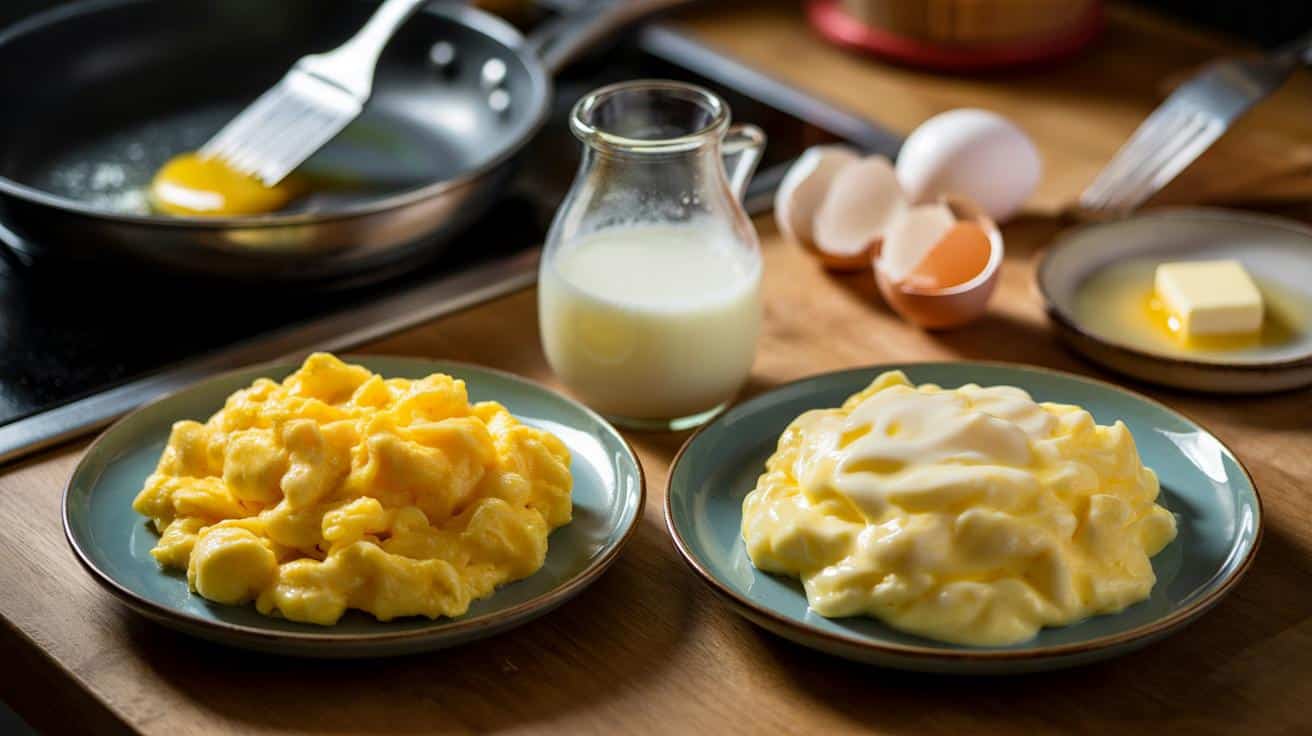
The pan is smoking slightly, the butter just on the edge of turning nutty brown.
You crack two eggs, pour in a splash of milk almost without thinking, and start beating with a fork. A small, domestic gesture you’ve seen a hundred times. Yet the difference on the plate is huge: one version rubbery and squeaky under the teeth, the other soft enough to almost spread on toast. Standing over the stove on a grey Tuesday morning, you can feel that tiny detail changing your mood for the day. The fork scrapes, the eggs start to set, and something subtle happens at the level you can’t see. Proteins quietly negotiate.
Why milk changes the way eggs feel in your mouth
The first clue hits you on the plate: eggs with milk feel almost cloud-like, while plain eggs can slip into that bouncy, chewy zone. Your tongue knows before your brain does. One bite gives you gentle resistance, then melts; the other pushes back with a tight, springy texture. Some people call it “luxurious”, others just say it feels less like breakfast in a canteen.
That softening isn’t magic. It’s milk proteins and water sliding into the spaces that egg proteins would normally lock up. The result: a looser, kinder network instead of a firm, rigid one.
Picture two home cooks on a Sunday. One whisks eggs with nothing added, cooks them fast on high heat and eats in three minutes. The other adds a small glug of whole milk, stirs slower, cooks low and takes their time. On the same number of eggs, the “milk version” usually looks larger, paler, and folds on itself like a duvet. Food scientists who’ve measured it talk about *lower hardness and higher moisture retention* in milk‑enriched eggs. Most people just say “these taste softer”.
Even cafés notice it. Some chains quietly tweak their scramble mix with dairy to get that reliable, cushiony texture that survives the pass. If you’ve ever wondered why hotel buffet eggs are strangely spongy, that’s the industrial version pushed too far. The right level is closer to what happens in your frying pan with a modest splash, not the catering carton.
Underneath the surface, eggs are basically a protein drama waiting to happen. Raw, their proteins are curled up and relaxed. Add heat and they unwind, cling to each other and build a network that traps water and fat. Without any other actors on stage, that network can pull tight, squeeze out moisture and turn dense. Milk shows up with its own proteins, fats, and sugars and interrupts this process.
Casein micelles and whey proteins in milk slip between egg proteins as they set. They act like buffers, spacing things out so the final structure is looser. The extra water in milk also has somewhere to stay, so the egg doesn’t dry out as much. That’s why milk-enriched eggs feel tender, even if you slightly overcook them. The science is dry on paper, yet the result is pure comfort on toast.
How to use milk proteins to soften your eggs at home
If you want that gentler texture, start small. For scrambled eggs, a good working ratio is about 1 tablespoon of milk for every 2 large eggs. Whisk the eggs first until the whites disappear, then add the milk and a pinch of salt. Beat until the mix looks uniform and a little frothy on top.
Cook on lower heat than you think you need. A thin film of butter in the pan, eggs in, then slow, lazy movements with a spatula. Pull the edges to the centre, tilt the pan, let the uncooked mixture run. Take the pan off the heat when the eggs are still slightly wet and glossy; the milk proteins keep working while they rest on the plate.
There’s a common fear that any milk will automatically “ruin” eggs or make them watery. That usually comes from heavy-handed use: half milk, half egg, or cooking on aggressive heat until everything seizes. A light hand matters. If your scramble is leaking liquid, it’s often a sign of overcooking: the tightening egg proteins are squeezing out moisture, including what the milk brought in.
➡️ “Poor people’s foods” resurface during price instability
➡️ Why mental clarity often follows physical order
➡️ Why consistency feels easier when expectations are flexible
➡️ The psychological reason emotional clarity often comes after rest
➡️ Radiator foil fails when airflow is misdirected
➡️ The practical habit that prevents small tasks from piling up
➡️ Why predictability feels calming during chaotic periods
➡️ Feeding birds helps until it disrupts migration timing
On the flip side, skipping milk doesn’t make you morally superior in the kitchen. Some chefs prefer pure eggs for control and intensity of flavour, and that’s fine. At home, the balance is different. You might want something that feels kinder on a tired morning, not a competition-level omelette. Soyons honnêtes : personne ne fait vraiment ça tous les jours.
“Milk doesn’t just dilute eggs, it negotiates with them,” says one London food scientist I spoke to. “It tells the egg proteins to calm down a bit in the pan.”
Think about where you actually want that softness. For a silky omelette, a teaspoon or two of cream or milk per egg can relax the texture without turning it floppy. For quiches or baked egg dishes, using milk or cream in the custard changes the entire set, giving you a tender slice instead of a squeaky sponge. On the flip side, if you’re making meringues or a soufflé, you keep milk away from the whites because you want the pure, tight foam.
- Use a small ratio: about 1 tbsp milk for 2 eggs.
- Whisk eggs smooth before adding milk and salt.
- Cook low and slow, stop while still slightly glossy.
- For richer softness, swap milk for single cream.
The quiet psychology of softer eggs
We often talk about taste, but texture is the thing that makes or breaks a dish in your memory. A rubbery omelette at a rushed breakfast meeting will stick with you for days. A soft, custardy scramble on a lazy weekend can do the same, in a much nicer way. On a small, daily scale, milk proteins are changing more than the egg; they’re shifting the tone of the whole meal.
There’s also something about tenderness in food that reads as care. When someone makes you eggs that are gently set, moist, a touch creamy, it feels like they’ve slowed down their day for you. That’s not just sentimentality. It’s your brain reading the cues: low heat, extra ingredient, patience. On a chemical level, milk is softening proteins; on a human level, it’s softening the moment. On a rough morning, that matters a lot more than the exact ratio of casein to whey.
On a wider scale, the way we talk about “proper” eggs often forgets real life. Online tutorials may insist on nothing but eggs, butter and perfect technique. At 7.30am, with a half-charged phone and a crowded commute ahead, most people just want something warm that goes down easily. On a tous déjà vécu ce moment où le toast brûle pendant qu’on cherche ses clés. In that chaos, a splash of milk turning a fast scramble into something gentler feels less like cheating and more like adaptation. The science is solid, yet the choice is personal.
| Point clé | Détail | Intérêt pour le lecteur |
|---|---|---|
| Rôle des protéines de lait | Caseine et whey se glissent entre les protéines d’œuf | Comprendre pourquoi les œufs deviennent plus tendres |
| Dosage pratique | Environ 1 c. à s. de lait pour 2 œufs | Reproduire facilement la bonne texture à la maison |
| Cuisson douce | Feu bas, arrêt avant cuisson complète | Éviter les œufs secs et caoutchouteux |
FAQ :
- Does adding milk to eggs always make them softer?Used in small amounts and cooked gently, milk generally gives a softer, moister texture by loosening the egg protein network.
- Is cream better than milk for scrambled eggs?Cream has more fat and fewer proteins, so it gives a richer, silkier result; milk gives light softness and a bit more volume.
- Can I use plant-based milks to soften eggs?Yes, though they lack casein, so the effect is more about added water and fat; soy and oat drinks usually work best.
- Why do my eggs go watery when I add milk?That’s usually from overcooking: the tightening egg proteins squeeze out liquid, which then pools on the plate.
- Is it wrong to cook eggs without milk?Not at all; plain eggs give a firmer, more pronounced egg flavour, it just means you rely entirely on heat control for tenderness.