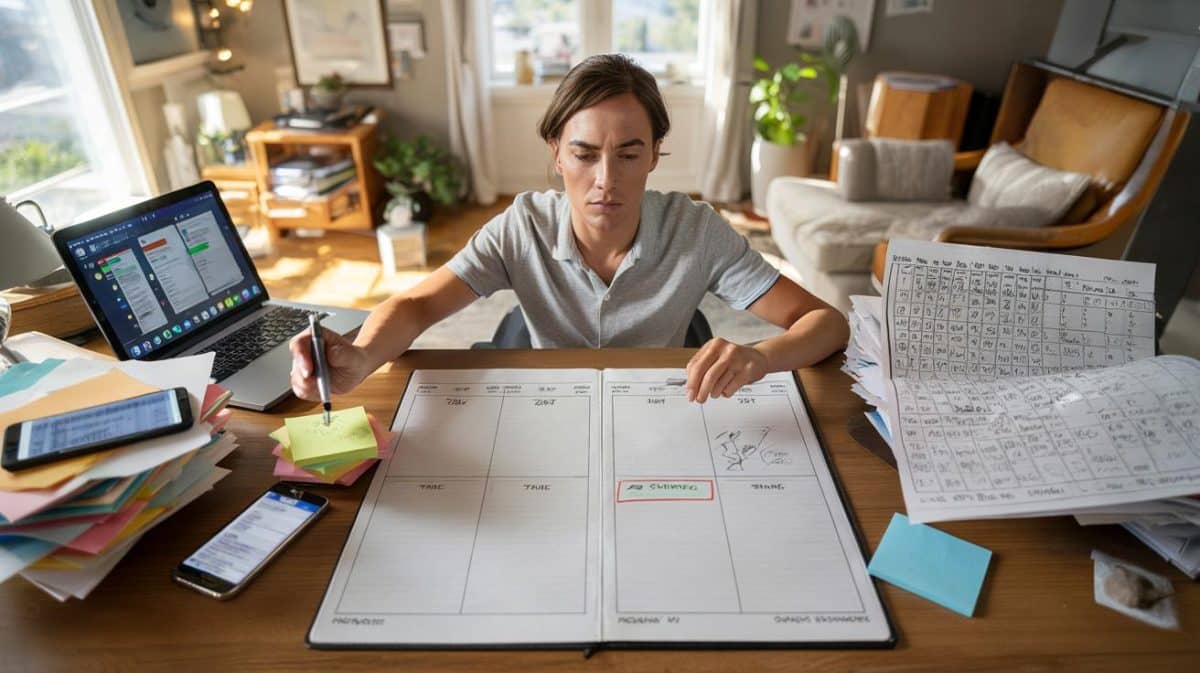
The emails start stacking up before you’ve even opened your eyes.
Your phone is already glowing on the bedside table. Three WhatsApp messages, one Slack ping, a calendar reminder flashing a meeting you’d forgotten you’d agreed to. You scroll, half-awake, and the day feels like it’s running at double speed before you’ve touched the floor.
In the kitchen, you’re spreading peanut butter on toast with one hand and answering a “Quick question?” with the other. Someone can’t find their keys. Someone else needs a lift. The kettle boils, then cools, untouched. Your coffee goes lukewarm while your brain quietly starts to overheat.
It’s not that the tasks are impossible. It’s the constant deciding. What first? What now? What next? That tiny mental negotiation repeats 80 times before 9 a.m. And that’s where a boring, predictable routine quietly becomes a life raft.
Why predictable routines lower the pressure on busy days
Watch someone who looks strangely calm on a packed weekday morning and you’ll often find the same thing: they’re almost on autopilot. Same mug. Same breakfast. Same order of tiny moves. It looks dull from the outside, almost robotic. Inside, they’ve simply taken the chaos out of the first hour.
Routines don’t remove work. They strip out decisions. You’re not standing in the kitchen weighing up cereal vs toast vs nothing. You’re not debating whether to check emails before or after the shower. Your body just moves through a familiar script, and your brain gets to idle for a moment. On a busy day, that idle time is worth gold.
There’s data hiding behind this quiet habit. Researchers talk about “decision fatigue”: the way too many small choices drain your self-control, your focus, even your mood. In one famous study, judges were more likely to grant parole earlier in the day. Later, when they were mentally tired from judging case after case, they defaulted to “no”. The decisions hadn’t changed. Their energy had.
Most of us don’t sign legal documents before breakfast, but we do run through a hundred tiny calls: grey shirt or blue, lunch at your desk or out, answer that email now or ignore it. Each choice shaves a little off your attention. By early afternoon, the tank is low. Routines act like guard rails. They remove whole clusters of choices from your morning, so the fuel’s still there when something big lands in your inbox at 11:47.
This is where predictability stops sounding boring and starts sounding like self-defence. When the day is already full of moving parts, a routine is a stabiliser. You know what happens at 7 a.m. You know what happens after you shut your laptop. That quiet certainty smooths off the sharp edges of a crowded calendar. Your brain can stop bracing for the next surprise and get on with the work that actually matters.
Turning “just routines” into a real support system
A helpful routine isn’t a Pinterest-perfect “5 a.m. millionaire morning”. It’s a small, repeatable script that answers one question: “What do I do first, without thinking, when my day is busy?” The easiest way to build it is to work backwards from your worst mornings.
Take a day that felt like a car crash. You woke up late, your bag wasn’t ready, your charger was missing, you answered a tense message in the wrong tone. Now strip that mess down to the parts you could automate. Bag by the door the night before. Keys and charger in the same bowl. One five‑minute check-in with yourself before you open anything that dings.
➡️ Driving safety debates ignore adaptive testing
➡️ Why mental clarity often follows physical order
➡️ Milk proteins soften egg texture
➡️ Radiator foil fails when airflow is misdirected
➡️ Neither strict routines nor chaos to manage busy days
➡️ The psychological reason emotional clarity often comes after rest
➡️ Keep your tank above half: the winter driving habit that prevents a surprisingly common breakdown
➡️ Why predictability feels calming during chaotic periods
Then, write a tiny script: wake, water, shower, get dressed, coffee, bag, door. No phone until coffee. *That* specific. Stick it on a Post‑it, on the fridge, or as your lock screen. The goal isn’t discipline. It’s to make your half-asleep self’s job so easy that your wide-awake self has energy left for what the day throws at you.
The trap many people fall into is trying to design a routine for the person they wish they were, not the person who actually lives in their flat. You know the kind: 40 minutes of yoga, journaling, a cold shower, reading three chapters of a non-fiction book before sunrise. Sounds incredible on paper. Lasts three days max in real life.
Soyons honnêtes : personne ne fait vraiment ça tous les jours.
A routine that works on busy days is often embarrassingly simple. Two minutes to make the bed. The same quick breakfast. One list of three tasks for the day, written while the kettle boils. If you’ve got kids, it might be just one fixed thing: everyone’s bags packed and lined up before 9 p.m. the night before. When life is crowded, one tiny predictable action beats ten inspirational ones you never repeat.
There’s also the shame piece. People feel they’ve “failed” at routines because they miss a day. They think consistency means “never break the chain”. Humans don’t work like that. You’ll get sick. You’ll travel. You’ll hit a week where everything goes sideways. The routine that survives is the one you can restart without guilt. Be kind to the version of you who will be tired, rushed, or overwhelmed. Build habits that welcome them back in, instead of telling them off.
“On the days when everything feels out of control, my routine is the only part of the day that doesn’t argue back,” a London nurse told me during a night shift break. “I don’t have to negotiate with it. I just do the next step.”
This is why the most powerful routines are almost boringly concrete. They’re not “be more organised”. They’re “10:15, make tea, check calendar, choose one hard task, put phone in another room for 25 minutes.” That level of detail turns vague intentions into muscle memory. Over time, your body starts moving before your doubts do. The routine runs like a quiet script in the background, freeing up your limited willpower for moments that really matter.
- Pick one tiny anchor: something you do every day anyway (coffee, brushing teeth).
- Attach one helpful action to it (check calendar, pack lunch, lay out clothes).
- Keep it easy enough that even your most exhausted self could still do it.
- Write it down somewhere visible until it feels obvious.
- When you fall off, restart with the smallest possible version, not the “perfect” one.
Letting routines hold you, without letting them hold you back
There’s a quiet freedom hidden in routines that often surprises people. Predictability sounds like a cage. It often behaves like a set of keys. When you know that certain parts of your day are already spoken for, it becomes oddly easier to say yes to the unexpected thing that arrives at 3 p.m.
A colleague drops an urgent task on your desk? Fine. Your “non‑negotiables” are covered: lunch, one deep‑work block, a short walk around the block. Because those are protected by routine, you can flex everything else with less stress. The structure takes the hit, not your health.
On a family level, routines also lower the emotional temperature. One parent I spoke to described their evenings before they agreed a simple script: “It felt like we were improvising chaos every night.” Now, weekdays follow the same rough pattern: dinner, ten minutes of clear‑up with music on, screens off, everyone on the sofa by eight.
No one’s timing it with a stopwatch. Life still interrupts. But the default is no longer a battlefield. On the nights when everyone’s tired and snappy, they can fall back on the pattern, instead of arguing about who does what next. That’s where routine quietly becomes a form of kindness.
For all this, routines aren’t a cure‑all. They won’t fix a toxic workload or create extra hours in a packed schedule. They will give you a stable floor to stand on while you decide what needs to change. That might mean spotting that your “busy day” has become every day, with no room left to breathe.
Once your core routines run themselves, you start to see the bigger patterns more clearly. You notice that you’re always working late on Wednesdays. You realise that the meeting that wrecks your week is always at the same time. With your mornings and evenings on rails, you have just enough spare attention to ask awkward questions about the rest. That’s where the real shifts often start: not in a productivity hack, but in noticing what your habits quietly reveal.
Maybe that’s the quiet promise of predictable routines. Not that life becomes neat and calm, but that your days stop feeling like an emergency you’re late to. You wake up, you follow a familiar script, and by the time the first surprise hits, you’ve already done the simple things that keep you steady. Your future self is a little less frantic. The day feels slightly more yours.
On a crowded morning commute, when everyone’s shoulders are tense and the train announcements are glitching, that small sense of ownership can be the difference between coping and burning out. Routines won’t make the world slower. They just stop every tiny choice from demanding your full attention. In a time when everything else is accelerating, that predictability is quietly radical.
| Point clé | Détail | Intérêt pour le lecteur |
|---|---|---|
| Routines réduisent les décisions | Elles créent des scripts prévisibles pour les moments chargés | Moins de fatigue mentale, plus d’énergie pour les enjeux vraiment importants |
| Petit vaut mieux que parfait | Une routine simple et réaliste résiste mieux aux journées compliquées | Facile à adopter, à maintenir et à relancer après un “raté” |
| Structure = liberté | Des habitudes stables protègent les besoins de base au milieu du chaos | Permet de gérer l’imprévu sans s’épuiser ni perdre ses repères |
FAQ :
- Are routines just another form of control freakery?Not really. Healthy routines reduce the number of boring decisions so you have more mental space for creativity, relationships and real problems, not less.
- How long does it take for a routine to feel natural?Studies suggest habits can take anywhere from three weeks to a few months, depending on difficulty. The easier the action, the faster it becomes automatic.
- What if my job is unpredictable and every day is different?Anchor routines to time-of-day rather than clock time: “after I wake up”, “when I get home”, “before I sleep”. Your shift can change, your script stays.
- Won’t I get bored doing the same thing every day?The “boring” bits are usually very short. They free up energy so the rest of your day can be more interesting, not spent fumbling for keys and losing emails.
- How many routines do I actually need?For most busy people, three are enough to start: a simple morning routine, a work‑start routine, and a wind‑down routine that signals to your brain that the day is closing.