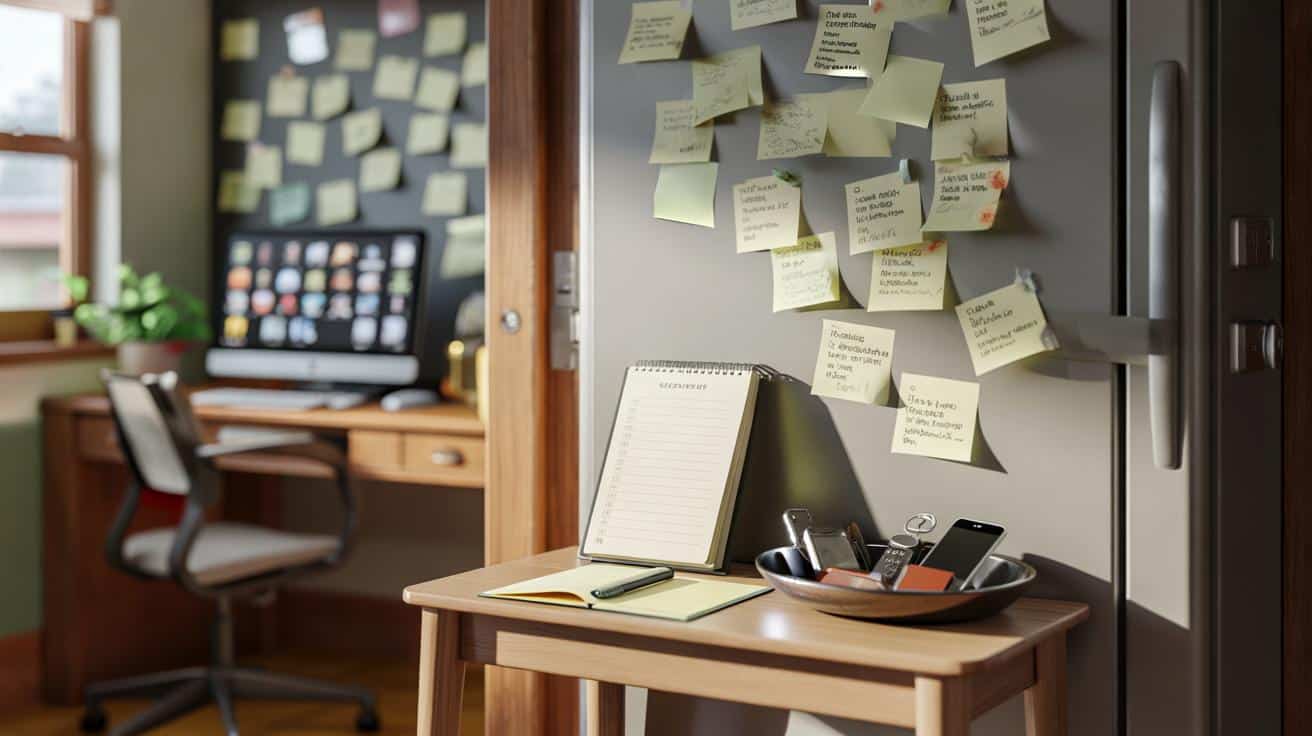
The note was still there, fluorescent yellow on the fridge, shouting “MUM’S BIRTHDAY – CALL!
!!” in thick black marker. At 10pm, you spotted it, reached for your phone… and saw three missed calls from her. The text message: “I guess you forgot.” Your stomach dropped. The reminder had been in front of your eyes all day. Your phone had pinged twice. And yet your brain had quietly skipped the one thing that actually mattered.
On the desk, a neat fan of sticky notes curls at the edges. Your lock screen is full of alerts you’ve swiped away without reading. It’s not that you don’t care. It’s that the old tricks don’t seem to work anymore.
What if the problem isn’t your memory at all, but the way you try to use it?
Why reminders and sticky notes keep failing you
You probably think you’re being organised. A reminder for the dentist. A sticky note for the parcel pickup. A calendar alert to “drink water” that you haven’t moved in months. Each one feels like a tiny insurance policy against forgetting.
Then real life hits. A colleague calls, your kid spills juice, an email pings with “urgent” in the subject line. The sticky note fades into the wallpaper of your day. Your brain does something sneaky: it stops treating those reminders as signals and starts treating them as noise.
By the time the thing you wrote down matters, the reminder has become invisible.
There’s a number productivity experts love to quote: people check their phones around 60 to 100 times a day. That sounds like the perfect opportunity for reminders to work. *Plenty of chances for your brain to notice the alert, right?*
Except that’s not what happens. Think about the last time your phone buzzed for something non-urgent while you were deep in a task. You glanced, swiped it away, promised yourself you’d handle it “later”. Later never came. Your brain had categorised that notification as “low priority background noise”.
Something similar happens with sticky notes on fridges, monitors, doors. The first day, they pop. By day three, they’ve become part of the scenery. You can stare straight at them and not really see them. It’s not laziness; it’s a survival trick. Your brain filters repeated stuff so you don’t go mad from constant signals.
So you add more: more reminders, more colours, more apps. Your system gets louder, your brain gets deafer, and the guilt piles up each time you miss something that was “right there in front of you”.
➡️ Driving safety debates ignore adaptive testing
➡️ Why consistency matters more than perfect systems
➡️ Keep your tank above half: the winter driving habit that prevents a surprisingly common breakdown
➡️ Feeding birds helps until it disrupts migration timing
➡️ Why mental clarity often follows physical order
➡️ Subsidence slows only when extraction stabilizes
➡️ Why predictable routines make busy days easier
➡️ The psychological explanation for emotional withdrawal during overwhelm
Underneath all this is a basic mismatch between the tools and the organ that uses them. Human memory was built for a world of physical cues, not digital pings and paper squares stuck everywhere.
Your brain loves context. It remembers that you need milk when you walk past the corner shop, not when a random notification drops during a Zoom call. It registers that the bin is full when you actually touch it, not when you see “take out rubbish” scribbled on a Post-it from two days ago.
Reminders and sticky notes pull tasks out of their natural context. They sit in a generic place – your screen, your fridge, your to-do app – and ask your brain to care. Under pressure, your attention goes to what’s emotionally charged or physically present, not what’s on a digital list. That’s why you remember the embarrassing thing you said in 2016, and forget your tax deadline.
What works better than reminders and sticky notes
The shift is simple to describe and harder to practice: move from passive reminders to active triggers. Instead of relying on random alerts, you build small, repeatable “if this, then that” loops into your day. That sounds technical; in reality it’s deeply human.
You already do versions of this. You brush your teeth after you shower, not because of a reminder, but because those actions have fused into one routine. You check your pockets when you leave the house because your body recognises the doorway as a checkpoint. That’s a trigger in action.
To stop forgetting important things, link them to something you already never skip. Take medication when you make your first coffee. Check tomorrow’s calendar right after you close your laptop in the evening. Pay one bill every time you sit down with your Saturday breakfast. The trigger does the remembering for you.
Most people try to fix forgetting by adding more tools. Another app. A smarter smartwatch. A bigger whiteboard. The quiet truth: tools don’t help if your attention never lands on them at the right moment.
Start by stripping things back. One small notebook you carry everywhere, not five half-used planners. One daily review moment, not ten scattered “when I have time” glimpses at your tasks. One visible place for truly critical things – like passports, keys, medical documents – that never changes.
Then accept something slightly uncomfortable: you will forget some stuff. The real win is making sure you don’t forget the same important thing twice. After each “how did I miss that?” moment, ask: what trigger could have caught this next time? That question, repeated calmly, is more powerful than any bright pink sticky note.
“Your brain is not a storage unit. It’s a decision engine. The less it has to remember, the better it can choose.”
To make this real, it helps to have a few anchor practices you return to, even when life gets chaotic.
- Daily “two-minute check” of tomorrow’s top three tasks
- A fixed “landing spot” for keys, wallet, phone near the door
- One shared family calendar that actually gets updated
- Simple labels on boxes, folders, and digital files you use weekly
- A short weekly reset: clear bag, clear desk, clear inbox to zero-ish
Soyons honnêtes : personne ne fait vraiment ça tous les jours. Yet when these habits fire even 60% of the time, they create a safety net that no barrage of random reminders can match.
Living with a brain that forgets – without feeling like a failure
There’s another layer to all this: the quiet shame that comes with forgetting. You forget a birthday, a form for school, a colleague’s name in a meeting, and you don’t just feel disorganised. You feel like a bad friend, a bad parent, a bad professional.
That shame pushes you into magical thinking. You buy elaborate systems in the hope that the “right” app will finally fix your brain. When it doesn’t, you blame yourself instead of the setup. The spiral continues. More notes. More guilt. Less actual change.
On a human level, the turning point often comes from something very small. Telling a colleague, “My brain drops things, so I write them down straight away.” Admitting to your partner, “If it’s not in the calendar, it doesn’t exist for me.” That honesty removes the mask and reduces the pressure to pretend you’re a walking hard drive.
We’ve all had that moment where you stand in a room, no idea why you went in there, feeling like your mind has sprung a leak. The difference isn’t between people who forget and people who don’t. It’s between those who try to solve it alone with louder reminders, and those who quietly rebuild their environment to work with the brain they actually have.
That might mean putting the parcel you need to post directly in front of the door so you literally trip over it. Asking a friend to text you the day before that medical appointment, not because you’re incapable, but because shared attention is stronger than solo willpower. Or deciding that “no more than three sticky notes at a time” is your new house rule.
The more you externalise your memory into simple, visible structures, the less your self-worth gets tied to what you happen to recall in a busy Tuesday afternoon. You start to see forgetting less as a personal flaw and more as a design problem you can slowly fix.
The quiet revolution here isn’t about never forgetting again. That’s a fantasy. It’s about choosing what deserves a rock-solid system and what can safely be allowed to slip. You’ll still miss the odd TV show, but you won’t miss the passport on the morning of the flight.
And something interesting happens when you stop fighting your brain and start designing around it. Your sticky notes get fewer, your reminders become rarer but more meaningful, and your mind feels a little lighter. Not perfectly organised, not productivity-influencer-level optimised. Just… calmer.
You might even find yourself looking at that bare fridge door, free of neon squares, and feeling oddly relieved.
| Point clé | Détail | Intérêt pour le lecteur |
|---|---|---|
| Context beats reminders | Tasks linked to real-life cues (doorways, meals, routines) are remembered more reliably than abstract alerts. | Avoids the constant ping fatigue and focuses memory where it actually works. |
| Triggers over tools | “If X, then Y” habits turn daily actions into anchors that carry important tasks with them. | Makes remembering feel automatic rather than like constant mental effort. |
| Design, don’t blame | Viewing forgetting as an environmental design issue reduces shame and invites practical fixes. | Helps readers feel less broken and more in control of small, concrete changes. |
FAQ :
- Why do I forget things even when I care about them?Your brain prioritises what’s emotionally intense or physically present in the moment, not always what matters long term. Stress, fatigue and constant notifications drain attention, so even meaningful tasks can slip through.
- Are reminders useless then?Not useless, just overrated. They work best as backup for a system of routines and triggers, not as the main strategy. A single, well-timed alert tied to a habit beats ten random pings.
- What’s one change I can make today?Pick one reliable daily moment – morning coffee, bedtime, commuting – and attach a simple check-in: look at tomorrow’s three most important things. Keep it under five minutes so it’s easy to repeat.
- How do I stop sticky notes from becoming invisible?Limit yourself to a maximum of three visible notes. When you add a new one, remove or act on an old one. Change their location regularly so your brain doesn’t file them away as background.
- What if my brain is just “bad at remembering”?Some people do have more fragile working memory, whether from ADHD, stress or other reasons. That’s exactly when environmental design, shared calendars, and clear triggers become powerful allies instead of “cheats”.