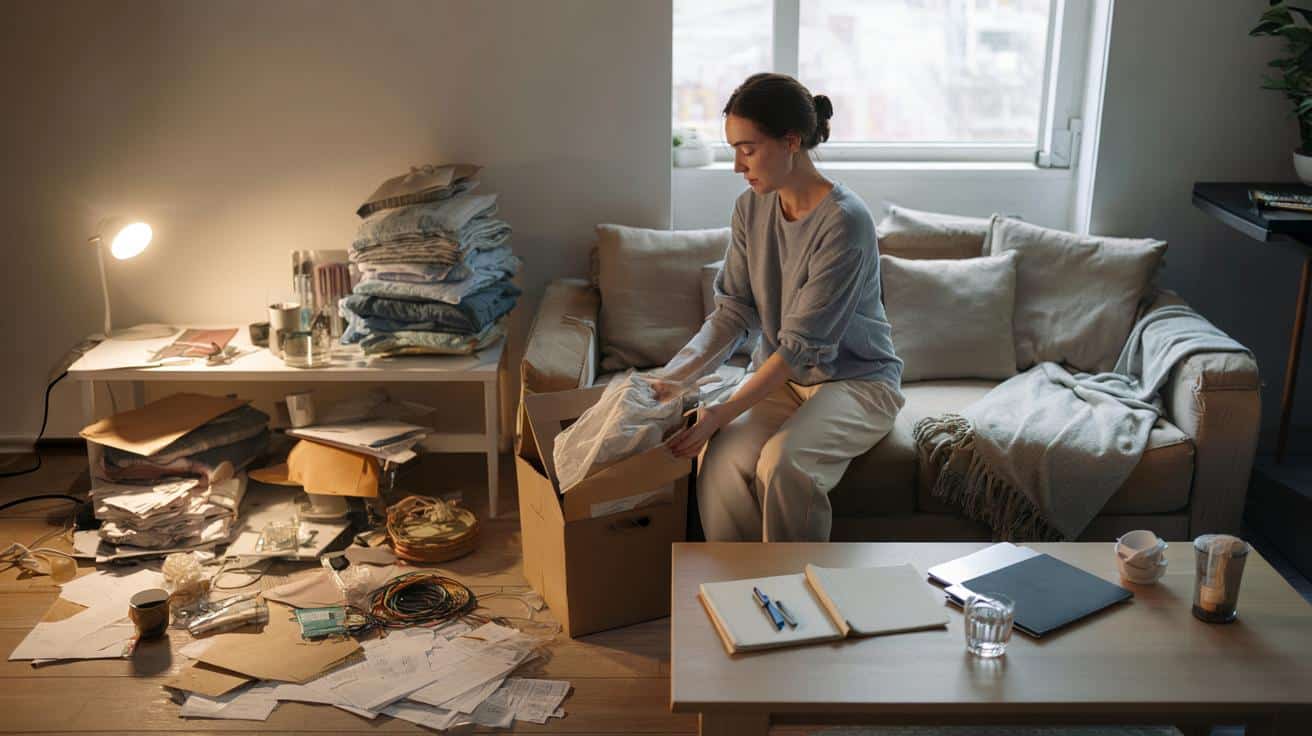
The kitchen table was never really a table.
It was a landing strip for unopened letters, half-folded laundry, chargers, glasses, things waiting for “later”. One Sunday afternoon, after a week that felt like walking through fog, Emma finally snapped. She put on a podcast, tied her hair up, and started clearing the piles she’d been stepping around for months.
It wasn’t glamorous. Old takeaway menus. A broken keyring. A receipt from two flats ago. She didn’t “Marie Kondo” her entire life. She just kept moving her hands – sort, bin, wipe, breathe. An hour later, the same room felt two sizes bigger. Her shoulders dropped. Her to-do list no longer looked like a monster, just a list.
Nothing dramatic had changed in her life. Yet her mind felt quieter. Almost sharper. Like someone had opened a window in her head.
When your space becomes your second brain
Walk into a messy room after a draining day and your body reacts before your mind catches up. Your eyes bounce from the chair piled with clothes to the dusty shelf to the sticky mug on the desk. You haven’t sat down yet, and you’re already tired. That’s not just laziness. That’s cognitive load kicking in.
Your environment constantly feeds your brain micro-signals. Each out-of-place object is a tiny reminder of something unfinished. Put enough of those reminders together and your attention frays. You feel scattered, not because you’re weak-willed, but because your surroundings are tugging at you from ten different directions at once.
Researchers from Princeton’s Neuroscience Institute found that clutter competes for your attention in the same visual field. In plain English: your brain has to work harder to filter out that leaning stack of books every time you try to write an email. You think you’re “just bad at focusing”. Your brain is actually doing overtime in the background, quietly exhausted by your own living room.
On a more human level, think about the classic “I’ll start after I tidy my desk” moment. A student sits down to revise, but the surface is buried under pens, empty coffee cups, random notes. She starts by clearing just enough space for her laptop. Ten minutes in, something shifts. She pushes the cups to the kitchen, gathers the notes into a pile, lines up two pens. It’s not perfect. Still, her breathing slows.
Her first page of notes is messy. By page three, the handwriting is calmer, the ideas land more cleanly. She hasn’t become smarter in half an hour. What changed is the amount of “noise” in her peripheral vision, and with it, the pressure on her prefrontal cortex – the part of the brain handling planning, decision-making, impulse control.
You see this in workplaces too. Teams that move from chaotic open desks to reasonably ordered, personalised workstations often report fewer “I lost that file again” panics. The work itself is just as hard, but friction drops. Less time is spent hunting for basics. That spare mental energy shows up as clearer decisions, kinder emails, sometimes even the courage to tackle difficult projects instead of procrastinating via small, scattered tasks.
Our brains like patterns. They soothe us. When our environment is one big “pattern break”, the nervous system stays slightly on guard. Messy surfaces don’t just look messy; they signal “unfinished business” to the subconscious. Over days and months, this looks a lot like mental fog, irritability, and the weird sense that you’re always behind, even when you’re sitting still.
➡️ Lawn regulations aim at noise complaints, not ecology
➡️ Subsidence slows only when extraction stabilizes
➡️ Milk proteins soften egg texture
➡️ How people regain focus after interruptions without restarting everything
➡️ Why predictable routines make busy days easier
➡️ Boiled citrus peels change indoor scent chemistry, not air quality
➡️ Radiator foil fails when airflow is misdirected
➡️ The mental reason people fear making the wrong choice more than no choice
Turning order into a mental reset button
One of the simplest ways to test the link between physical order and mental clarity is a five-minute reset routine. Pick a single, small area: your bedside table, your laptop desktop, the passenger seat of your car. Set a timer for five minutes, no more. Your only job is to decide: keep, relocate, or throw.
Don’t build a new personality around it. Just let your hands move while your brain narrates: “This is rubbish.” “This goes in the drawer.” “This doesn’t belong here.” When the timer stops, you stop. Then notice, without forcing it, how your mind feels when you next sit or lie near that spot. Often, the shift is subtle – a tiny exhale that wasn’t there before.
Routine helps. Many people swear by the “closing ritual” at the end of the workday: clear the desk, write tomorrow’s top three tasks on a sticky note, close all tabs. At home, the sibling habit is the five-minute “reset the room” before bed: cushions roughly back, dishes out of sight, blanket folded once. *Nothing Instagrammable, just less visual noise.* Over time, your brain starts to associate these gestures with switching mental modes – from on to off, from scattered to settled.
The trap is perfectionism. You see minimalism on social media and think, “If I can’t transform my flat into a beige sanctuary this weekend, what’s the point?” Then nothing happens for months. Or you do a massive clear-out in a burst of energy, bag up half your wardrobe, and burn out so hard you resent the whole idea of tidying.
On a rough day, the floor-drobe will win. Emails will pile up. Soyons honnêtes : personne ne fait vraiment ça tous les jours. Real clarity doesn’t come from a one-off “deep clean”, it comes from a realistic relationship with your stuff. It’s saying: today, I can manage my bedside table and my backpack. Tomorrow, we’ll see.
We also tend to moralise clutter. Messy equals failure, tidy equals virtue. That shame makes it harder to start, because every pile is a mirror. Far kinder – and more effective – is to look at clutter as data. Those shoes dumped by the door? Maybe you need easier storage. The overflowing paperwork? Maybe your admin system is broken, not you. Order then becomes a support act for your brain, not a judgement on your character.
“Your home should be the antidote to stress, not the cause of it.” – An interiors therapist once said this in a workshop, and the room went very, very quiet.
To keep it practical, it helps to frame physical order as a series of tiny experiments instead of a personality overhaul:
- Choose one “clarity zone” (desk, kitchen counter, bedside).
- Give it five to ten minutes of attention daily for one week only.
- Notice, honestly, any change in focus, sleep, or mood.
Some people discover that a clear desk changes everything, while their wardrobe can stay semi-chaotic without drama. Others realise that making the bed is their non-negotiable anchor. The point isn’t to copy anyone else’s version of order. It’s to find the minimum amount of tidiness your mind needs to feel less hunted by its own environment.
Living lighter in your own head
There’s a quiet power in walking into a room that isn’t fighting you. A clear table inviting you to sit. A bed not buried in clean clothes. A laptop screen without 47 icons winking at you. On a stressed morning, those small pockets of order can feel like someone left you a note saying, “You’ve got this. Start here.”
On a screen, this all sounds simple. In real life, it’s entangled with fatigue, kids, flatmates, deadlines, money, mental health. Some weeks the best you can do is move dirty mugs to the sink and clear enough space to put your bag down. Still, those micro-acts matter. Your nervous system registers them as small wins, and the story in your head shifts from “my life is a mess” to “my life has corners that are under my care”.
On a deeper level, physical order confronts a sticky question: how much of what surrounds you is chosen, and how much is just… left over? From past jobs, past relationships, past versions of you. Sorting through it is rarely just about objects. Emotions surface. Old ambitions, too. That’s why mental clarity often arrives not in the bin bag itself, but in the decision to keep or release what no longer serves you.
We’ve all lived that moment where, after finally clearing one small area, you sit down and suddenly know what email to write, what call to make, what problem to tackle first. The fog lifts just enough to see the next step. Not the whole path, just the next metre. On tough days, that’s plenty.
| Point clé | Détail | Intérêt pour le lecteur |
|---|---|---|
| Clutter drains focus | Every visible item competes for attention and adds mental load. | Helps explain why you feel tired and distracted in messy spaces. |
| Small zones, big impact | Targeted five-minute resets can shift how a whole room feels. | Makes tidying more doable and less overwhelming. |
| Order as self-support | Physical order is a tool, not a moral scorecard. | Reduces shame and encourages sustainable, kind habits. |
FAQ :
- Does a tidy space really improve mental health?Not like a magic pill, but studies link lower household clutter to reduced stress and better mood, especially in people already under pressure.
- What if I’m naturally messy and still productive?Plenty of creative people thrive in “organised chaos”. The key is whether your space supports your work and rest, not how it looks on Instagram.
- How do I start if I’m completely overwhelmed?Pick one surface, set a five-minute timer, and stop when it rings. Repeat for a week before attempting anything bigger.
- Is minimalism the only way to achieve mental clarity?No. You don’t need empty shelves, just less visual noise and systems that fit your real life, not a showroom.
- How do I keep things tidy once I’ve decluttered?Attach tiny resets to existing habits: clear the table after dinner, close tabs when you log off, reset the sofa before bed. Think rituals, not revolutions.