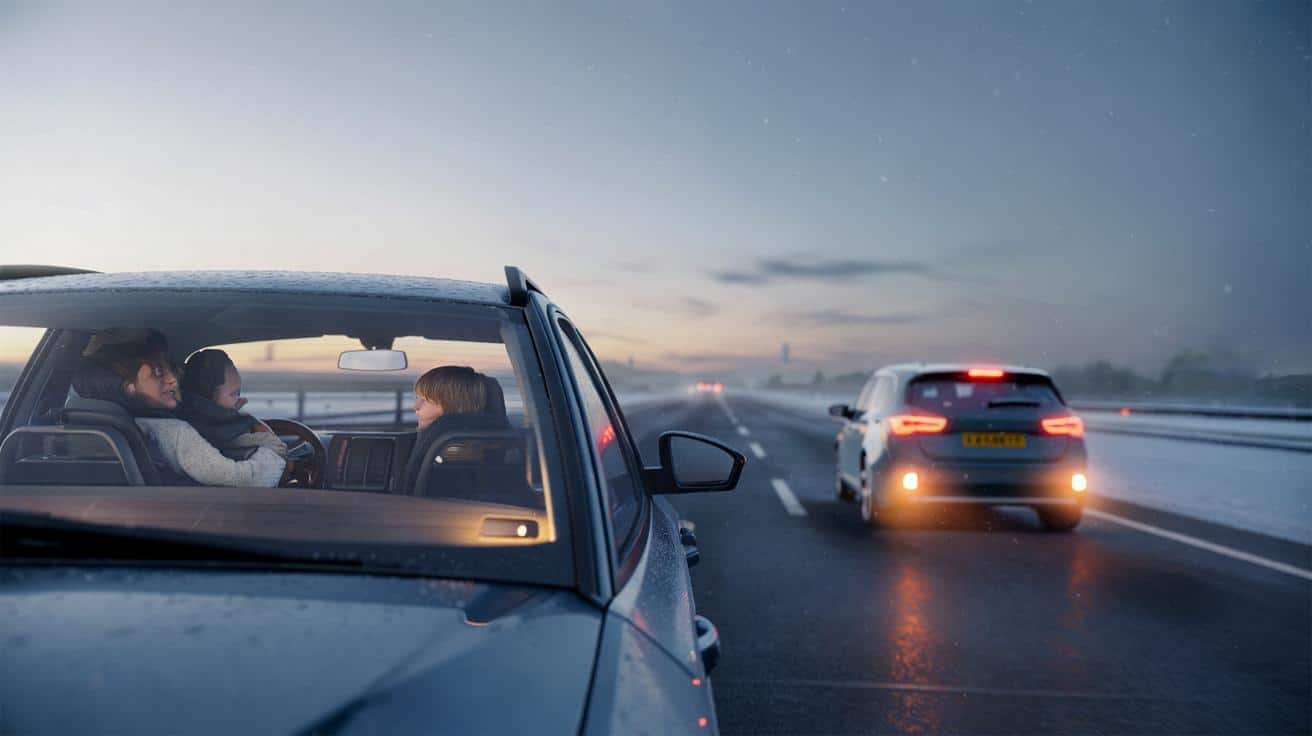
The fuel light flickered on just as the first flakes started hitting the windscreen.
Typical. Friday rush hour, kids in the back, a queue snaking out of the petrol station, and that sinking feeling that you’ve pushed your luck one trip too far. Outside, the temperature is dropping fast. Inside, the heater is on full blast and the range counter is playing mind games: 18 miles, 12 miles, 6 miles…
You inch forward in traffic, watching drivers peel off towards the services ahead. Then, two cars in front, someone’s hazard lights flash on. Their car rolls to a stop in the middle lane. No crash. No steam. Just no fuel. Winter doesn’t forgive that kind of gamble.
What most drivers don’t realise is that running low in cold weather can trigger a whole chain reaction of problems that have nothing to do with “forgetting to fill up”. And there’s a simple, old‑school habit that quietly stops one of the most common winter breakdowns.
Why that “just above empty” habit bites harder in winter
On a mild summer evening, running the tank down to fumes feels like a low‑stakes game. The air is warm, the roads are dry, and the worst outcome seems to be an embarrassing walk with a jerrycan. Winter changes the rules. Cold air, damp roads and long nights turn a casual risk into something sharper.
Breakdown patrols across the UK see it every year. The first proper cold snap arrives and call‑outs spike, not just for flat batteries, but for cars that simply give up after a few miles of stop‑start driving. The driver swears they had enough fuel and, technically, they’re right. The gauge says a quarter. The car disagrees.
We like to think of a fuel tank as a simple box with liquid sloshing around, but winter turns that box into a small chemistry experiment. Moist air gets drawn in, condenses on cold metal walls and drips down into the fuel. One short journey after another, that moisture builds. When levels are low, there’s more air, more condensation and less margin for the engine to cope.
Take a typical Monday school run on a frosty January morning. You start the car, scrape the windscreen with numb fingers and watch your breath fog up the cabin. The needle hovers just above the red but you reckon you’ll “grab some fuel later”. You drive three miles, park, switch off. Two hours later, you repeat in reverse. That’s four cold starts, two short journeys and the engine never really warms through.
Now imagine that same pattern repeated every weekday for weeks, on a tank that rarely sees more than a third full. The fuel pump sits half‑exposed, working harder than it should. Any tiny bit of debris in the bottom of the tank gets churned up again and again. The engine management system is constantly juggling cold fuel, cold air and stop‑start traffic.
By the first long weekend trip, the weak point appears. Maybe the car stutters turning out of a junction. Maybe it dies on a roundabout and refuses to restart. That “should be enough” level on the gauge turns out to be a dangerous assumption once winter has been quietly working away in the background.
The logic is simple, even if we don’t think about it day to day. A fuller tank means less space for moist air, so less condensation. The fuel stays more consistent in temperature and quality. The pump, which is cooled and lubricated by the fuel around it, has a kinder life. Running a tank near empty now and then won’t magically wreck a modern car, *but* habitually hovering just above the red in cold weather nudges everything in the wrong direction.
➡️ Boiled citrus peels change indoor scent chemistry, not air quality
➡️ Feeding birds helps until it disrupts migration timing
➡️ Why predictable routines make busy days easier
➡️ Why people who feel organized rarely rely on memory alone
➡️ The mental reason people fear making the wrong choice more than no choice
➡️ The practical habit that prevents small tasks from piling up
➡️ Radiator foil fails when airflow is misdirected
➡️ Subsidence slows only when extraction stabilizes
That’s why roadside patrols talk about “self‑inflicted breakdowns” in winter. Not because drivers are careless or lazy, but because modern cars are so good at hiding their complaints until they suddenly stop. Keeping the tank above half doesn’t feel dramatic. There’s no app notification or dashboard fanfare. Yet that one small change removes several of the silent stresses that pile up in the cold months.
The quiet winter habit: keep it above half
The simplest winter driving tweak costs nothing and takes no special skill: treat half a tank as your new “empty”. When the needle drops to that midpoint, that’s your cue, not the glowing orange light buried in the dashboard. It sounds fussy. In practice, it just means nudging your refuelling a few days earlier than usual.
One way to make it painless is to link it to a routine. Fill up after the big weekly shop, not “whenever I remember”. Top up on the way home from work on a Thursday, not when the light nags you on Saturday morning with two kids in the car. The more automatic it feels, the less it becomes another thing on the mental to‑do list.
Think of that half‑tank line as a buffer against winter’s mood swings. A buffer against surprise delays, frozen car parks, closed lanes and that long tailback you didn’t see coming on the M1 in sleet.
Here’s the awkward truth: most of us have danced far too close to the edge with fuel at some point. You glance at the gauge, see the equivalent of “a few quid” left and mentally calculate how many miles you can squeeze out before payday, or before the cheaper supermarket station. On a clear summer evening with plenty of daylight, it feels almost like a game. In freezing rain, with a tired child in the back and a yellow weather warning on your phone, it suddenly doesn’t.
The common mistakes are rarely dramatic. Ignoring the fuel warning light for “just one more day”. Assuming every service station on a long A‑road will be open at night. Forgetting that using the heater, heated seats, demister and lights has an indirect impact on how the car runs, especially when it’s already working harder in the cold. No one sets out thinking, “I’m going to risk a breakdown today.” Life just piles on, and refuelling slips further down the list.
Being kind to yourself means accepting that, and quietly changing the rules of the game. Instead of waiting for the car to beg, you give it what it needs while the day is still going your way.
As one seasoned patrolman put it after pulling yet another shivering family off a hard shoulder at dusk:
“Ninety per cent of the winter fuel breakdowns I see didn’t have to happen. People don’t run out of fuel in one bad decision. They get there one small gamble at a time.”
His view is echoed by breakdown statistics that rarely make the headlines but tell the same story year after year. Low fuel, contaminated fuel and fuel pump failures sit quietly alongside dead batteries as core winter call‑out causes. They don’t generate dramatic photos, yet they ruin weekends just as effectively.
- Keep your tank above half once the temperature drops.
- *Plan refuelling around your weekly routines*, not last‑minute panics.
- Don’t trust the fuel light as your main guide in winter driving.
- Use long journeys to refill, rather than repeatedly “just enough”.
- Listen to small stutters or hesitations instead of ignoring them.
Driving through winter with a bit more margin
Something subtle happens when you stop treating fuel like an afterthought in the colder months. The car feels less like a fragile machine you’re constantly apologising to, and more like a partner you’re keeping ready for whatever the week throws at you. That mental margin matters as much as the mechanical one.
On a dark December morning, with frost tracing patterns on the bonnet, knowing you’ve got a healthy buffer of fuel changes your mood before you even turn the key. You’re not gambling on the next open station or praying the traffic report stays clear. You’ve already taken that particular worry out of play. That space in your head can go to reading the road, watching for black ice, or simply having an actual conversation with the person next to you.
We don’t talk much about these small, almost invisible acts of care for ourselves and our cars. They don’t make for dramatic social media posts or heroic stories at the pub. They’re quiet, boring, and easily skipped on a busy Wednesday. Yet they’re also how winters are survived without incident, how kids are collected on time from football practice in freezing fog, how last‑minute trips to see family don’t turn into expensive, freezing waits on the shoulder.
Think back to your own close calls with the fuel gauge, the ones where your heart rate crept up and every mile felt like a negotiation. Those memories linger for a reason. They’re little reminders that, under all the tech and clever dashboards, driving in winter is still a negotiation with the elements.
Changing the habit of a lifetime sounds big. In reality, it boils down to a few slightly earlier stops at the pump and a quiet decision: “half is my new empty when it’s cold.” Nothing glamorous. Nothing Instagrammable. Just you, your car, and the choice to make winter driving a touch less fragile.
Maybe that’s the kind of tip worth passing on at work, or mentioning to a new driver in the family. Or quietly adopting yourself, the next time the first real frost glitters on the pavement and the tank is hovering a bit too close to the line.
| Point clé | Détail | Intérêt pour le lecteur |
|---|---|---|
| Garder le réservoir au‑dessus de la moitié | Réduit la condensation, protège la pompe à carburant et stabilise le fonctionnement du moteur | Moins de risques de pannes imprévues par temps froid |
| Changer le moment où l’on fait le plein | Lier le ravitaillement à des routines hebdomadaires plutôt qu’à l’allumage du voyant | Allège la charge mentale et évite les situations d’urgence |
| Anticiper les conditions hivernales | Tenir compte des embouteillages, des fermetures de stations et des trajets de nuit | Permet de voyager avec plus de sérénité et de sécurité en hiver |
FAQ :
- Does keeping my tank above half really make a difference in winter?Yes, because it reduces condensation inside the tank, keeps the fuel pump better cooled and lubricated, and gives you a safety buffer if traffic or weather suddenly worsens.
- Can modern cars cope with running close to empty?They usually can occasionally, but doing it often in winter increases strain on the fuel system and leaves you far more exposed to delays or unexpected detours.
- Is condensation in the fuel tank still an issue with newer vehicles?It’s less dramatic than on older cars, but moisture can still accumulate over repeated cold starts and short journeys, especially when there’s lots of air space in the tank.
- How often should I refuel in winter to stay above half?There’s no fixed rule, but many drivers find that topping up once a week, linked to a regular errand or commute, keeps the gauge comfortably above the halfway mark.
- What if I can’t afford to fill the tank fully?You don’t need to brim it every time; adding smaller amounts more often, as soon as you drop near half, is still kinder to the car than repeatedly running it close to empty.