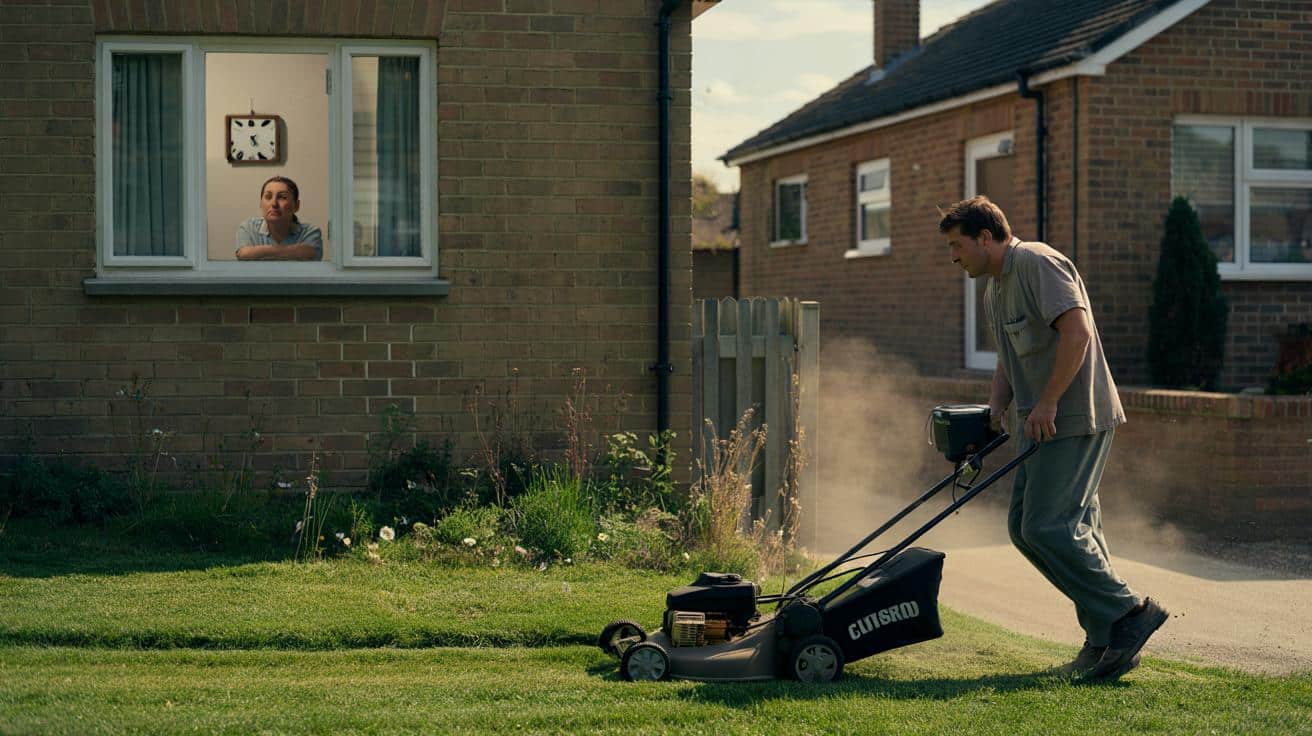
The mower starts before the kettle’s even boiled.
A high‑pitched whine slices through the cul‑de‑sac, bouncing off brick and double glazing. A curtain twitches. Someone checks their watch. It’s 7.58am and the Sunday quiet is already gone.
Across Britain and much of the world, the same little drama plays out every weekend. Engines, strimmers, leaf blowers, sprinkler systems. People timing their domestic battles with the grass, while neighbours silently weigh up whether this counts as “too early”.
Local councils respond with rules: time slots, decibel limits, enforcement hotlines. Whole sections of municipal websites are now devoted to “garden noise”.
Very few of those lines mention climate, pollinators or soil.
The regulations are aimed squarely at our ears, not our ecosystems.
Lawn rules written for the human ear, not the living ground
Walk through any suburban street in summer and you can hear the law in action. Lawnmowers roar into life after 8am, fall silent again by early evening. People hover at the window, waiting for the “allowed” hour like they’re counting down to New Year.
The grass, of course, doesn’t care about decibels. It cares about blades, timing, chemicals, drought. Yet our official guidance focuses almost entirely on how loud your mower is and when you’re allowed to use it. The living, breathing reality underfoot is treated like background scenery.
Noise is measurable. Ecology is messy. Guess which one wins in a by‑law.
Take one leafy London borough in 2024. After a spike in noise complaints, the council launched a campaign: no powered garden tools before 8am on weekdays or 9am on Sundays. Residents got letters, posters, an online form to report offenders.
In the same area, biodiversity officers were quietly begging people to stop mowing their lawns into oblivion. Barely any mention of that made it into the glossy leaflets. The headline message was all about respecting your neighbour’s peace and quiet.
➡️ Why predictable routines make busy days easier
➡️ Neither strict routines nor chaos to manage busy days
➡️ Feeding birds helps until it disrupts migration timing
➡️ The unnoticed link between posture changes and emotional state
➡️ Neither reminders nor sticky notes to stop forgetting important things
➡️ The mental reason people fear making the wrong choice more than no choice
➡️ “Poor people’s foods” resurface during price instability
➡️ The psychological reason emotional clarity often comes after rest
Across the UK, noise complaints about garden equipment have surged. The Local Government Association points to thousands of calls a year, many about lawn care. Councillors sit through meetings about mower curfews while bees and butterflies vanish from the verges outside.
It’s not that noise rules are pointless. Sleep matters; nerves fray. Yet when you look closely, a pattern appears. Our laws reflect the things humans notice immediately: sound, mess, “neatness”.
Grass that’s a bit too long gets labelled “untidy”. A mower that’s a bit too early gets a warning letter. Nobody fines you for stripping a garden of habitat as long as it’s quiet and looks respectable from the pavement.
Short lawns and trimmed edges are still coded as “good neighbour” behaviour. Wild patches and dead leaves read as laziness. So regulations drift towards maintaining that social norm: quiet, tidy, controlled. Ecology enters the conversation in tiny footnotes, if at all.
We are regulating the performance of lawn care rather than its impact. Volume and timing, not soil health or insect life. The result is a kind of green theatre that feels responsible, while the real damage happens in silence.
Turning a noisy problem into a quiet revolution in your garden
There is another way to read the rule book. Take those restricted mowing hours as an invitation to do less, not just to reschedule the same routine. If your council says no mowing before 10am on Sundays, that’s two extra potential hours of stillness for birds, insects and you.
A simple method: cut the lawn less often, and when you do, mow on the highest setting. Let some patches grow out fully. *You don’t need to transform the whole garden into a meadow overnight.* Just designate one corner where the mower never goes, and watch what moves in when the engine moves out.
Swap one noisy session with the petrol mower for a shorter, quieter pass with a manual reel mower or an electric one. Less roar, less fuel, more space for life to creep back between the blades.
Most people aren’t lawn fanatics. They’re just trying not to annoy anyone. On a cramped street with thin walls, the fear of becoming “that neighbour” weighs a lot heavier than an abstract chart about pollinator decline. On a hot Sunday, you might eye the mower and think about the noise, the looks, the WhatsApp group drama.
Soyons honnêtes : personne ne fait vraiment ça tous les jours.
So aim small. A slightly shaggier strip along the fence. Leaving the dandelions for a fortnight. Skipping one mow a month in peak summer. **That** is what a realistic, ecological response to noise rules looks like in a real life of tired evenings and busy weekends.
When enforcement letters arrive, remember they’re written for worst‑case scenarios: someone running a petrol strimmer at midnight, not you letting clover bloom quietly in the shade.
“Our by‑laws were written in a world where the main fear was waking up the neighbours,” admits a UK environmental planner I spoke to. “We’re only just starting to realise that a silent, over‑mown lawn can be just as harmful in the long run – just not to people who vote, but to everything that lives underneath.”
There’s an odd emotional gap in the way these rules are framed. We talk about decibels, not the way a garden feels when it’s full of life. On a summer evening with no engines running, you can hear the soft rustle of long grass and the ticking of beetles in the flowerbeds. On a cul‑de‑sac, that soundscape is rare – and precious.
- Small changes count: higher mower setting, fewer cuts, one wild corner.
- Talk to neighbours: explain you’re cutting less for wildlife, not neglecting the place.
- Choose quieter tools: electric or manual over petrol when you can.
- Use no‑mow hours as a prompt to simply stop, not just to delay.
- Remember: a peaceful street and a living lawn can exist together.
From noise complaints to a bigger conversation
On some level, lawn rules are about control. Councils trying to manage tension. Neighbours negotiating an invisible line of tolerance. It’s easier to argue about noise than to admit we’re wrestling with deeper questions: what is a garden for, and who gets to decide what “good” looks like?
We’ve slid into a narrow version of “good”: quiet, flat, green, trimmed. Yet the more we learn about ecology, the more that picture looks strangely sterile. A perfect lawn in a silent street can be a biodiversity desert. An imperfect patch of mixed grass, clover and wildflowers buzzing with insects might technically break some unwritten aesthetic rule, but it supports a richer world.
We’re at the point where local rules written for human comfort are brushing up against planetary limits. Not dramatically, not all at once. Just in hundreds of small, everyday choices about when to mow, what to spray, what to leave alone. The regulations won’t catch up overnight. In the meantime, every garden is a quiet test case of what we value most.
| Point clé | Détail | Intérêt pour le lecteur |
|---|---|---|
| Les règles visent le bruit | La plupart des règlements municipaux encadrent les horaires et les décibels, très peu la biodiversité | Comprendre pourquoi votre voisin se préoccupe plus de l’heure du tonte que des abeilles |
| Mieux utiliser les “heures calmes” | Réduire la fréquence de tonte, relever la hauteur de coupe, laisser des zones sauvages | Transformer une contrainte en levier discret pour un jardin plus vivant |
| Parler d’écologie en langage de voisinage | Explorer comment expliquer vos choix sans déclencher de conflit | Garder la paix dans la rue tout en changeant vos pratiques |
FAQ :
- Can I get fined for letting my lawn grow long?In most UK areas, long grass alone isn’t an offence. Problems start if it’s judged to cause a “nuisance” – for instance harbouring rubbish or blocking public paths. Ecologically managed but tidy‑edged wild patches are rarely targeted.
- Are electric mowers really better than petrol ones?Yes, in several ways. They tend to be quieter, produce no direct exhaust fumes and often encourage shorter, more mindful mowing sessions. The grid isn’t perfect, but they’re generally a step up from small petrol engines.
- What’s a simple ecological change I can make under current rules?Cut half as often and raise your mower blades. This single tweak reduces stress on soil life, lets flowers set seed and still keeps the lawn recognisably “kept” for neighbours and councils.
- How do I explain my messy‑looking lawn to neighbours?Frame it as a positive choice: you’re creating a small refuge for bees and butterflies. Point out any flowers or birds that have appeared. Most people respond better to a story than to a lecture on climate or policy.
- Could councils change lawn rules to include ecology?They already are in some places, by trialling “No Mow May”, wildflower verges and pesticide‑free policies. Extending that thinking into residential guidance – through education rather than punishment – is the next logical step.