In a quiet terraced street in Leeds, Tom thought he’d beaten his energy bills.
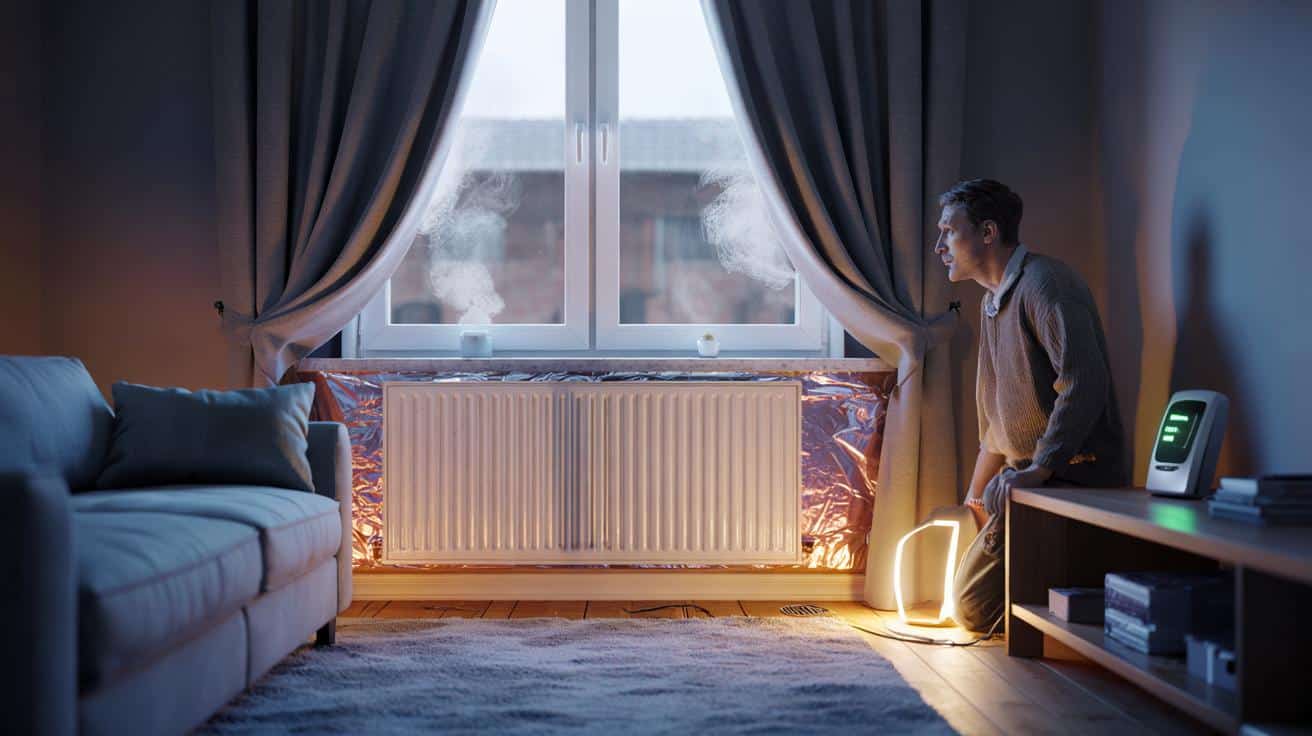
Silver radiator foil, perfectly taped behind every panel, a smart meter glowing like a trophy. He’d watched three YouTube videos, read two money-saving threads, and spent his Sunday shuffling furniture by himself.
Then January hit. The living room stayed stubbornly chilly, the curtains twitched slightly in a weird upward draught, and the heat seemed to disappear into nowhere. The gas bill didn’t flinch. Tom stood there, hand on the radiator, feeling the warmth on metal… and the cold on his face.
The foil was doing *something*. Just not what he thought.
When radiator foil works on paper, but not in your living room
You notice it the first time you walk past: the radiator is hot, your hand feels it, yet the room still has that thin, nagging chill. Your walls look “upgraded” with shiny foil behind the rads, but your toes on the floor tell a different story. The heat is there. It’s just not where you are.
Radiator foil is sold as a clever hack, a quick win against rising bills. Reflect heat back into the room, save money, get cosy. That’s the promise. The reality? If the airflow around your radiator is misdirected, the foil may as well be an expensive poster you never look at.
Heat doesn’t only travel in straight lines like a torch beam. It moves with air. Misguide the airflow and the foil quietly stops helping.
Take Sarah, who lives in a rented flat in Bristol with single-glazed windows and permanently cold floors. She lined every external wall radiator with foil, feeling virtuous and organised. Then she slid a chunky sofa right in front of the biggest radiator, because that was the only place it “really fit”.
On the smart meter, usage barely budged. Yet her thermostat showed the radiators hitting temperature quickly. She noticed something odd: the wall behind the foil felt faintly warmer, but the middle of the room was a cold bubble. The hot air had nowhere to rise, trapped and circling behind the sofa like steam behind a closed shower curtain.
She tried a smaller side table instead of the sofa. Within a week, visitors were saying the room “felt nicer”, even though the thermostat setting was the same. No new boiler. No extra insulation. Just less blocked airflow and suddenly the foil had a chance to do its job.
At the heart of this story is a simple clash: radiation versus convection. Radiator foil tackles radiant heat, bouncing it back off cold external walls. Sounds clever, and it can be. But in real homes, most of the warmth you actually feel comes from convection — hot air rising off the radiator, circulating around the room and slowly warming surfaces, furniture, you.
➡️ Why mental clarity often follows physical order
➡️ The mental reason people fear making the wrong choice more than no choice
➡️ Neither strict routines nor chaos to manage busy days
➡️ Why people who feel organized rarely rely on memory alone
➡️ Milk proteins soften egg texture
➡️ Lawn regulations aim at noise complaints, not ecology
➡️ The psychological reason emotional clarity often comes after rest
➡️ Keep your tank above half: the winter driving habit that prevents a surprisingly common breakdown
When that air is misdirected — trapped behind furniture, pushed up behind heavy curtains, or funneled into alcoves — your radiator starts heating pockets of dead space. The foil might reduce heat loss through the wall, yet the room still feels underheated, so the boiler runs longer. The physics is fine. The layout is not.
The real trap is psychological. You stick up shiny foil and subconsciously relax. You expect the bills to drop. You don’t question the airflow that quietly sabotages the whole thing.
How to stop your shiny foil turning into a shiny waste of time
If you already have radiator foil up, the next step isn’t more product. It’s air. Stand in front of each radiator and picture the path of hot air like smoke rising from a candle. First, it rises straight up. Then it curls forwards into the room. That invisible loop is what actually warms you.
Give that loop space. Leave a small gap between the radiator and any furniture — even 10–15 cm makes a real difference. Lift heavy curtains so they don’t hang over the radiator like a lid. If your window sill is deep, consider a slim deflector that nudges air outwards instead of trapping it against the glass. Let the foil reflect, and let the air move.
On a cold evening, try this small experiment with one radiator. Turn the heating on, then sit quietly and move your hand slowly above the panel, from bottom to top. You’ll feel that rising column of warmth. Now slide a chair right in front and repeat. The difference is immediate: the air slows, curls weirdly, or disappears behind the obstacle.
Now imagine that happening all winter. Multiply it by every blocked radiator in the house. The boiler keeps firing, trying to hit your thermostat setting, while microclimates of hot air idle behind sofas, cabinets, and floor-length drapes. You’re not “bad” at energy saving; your room is just badly arranged for it.
We’ve all seen those Instagram-perfect living rooms, with radiators fully hidden behind covers or boxed into alcoves. They look tidy. They also quietly kill airflow. The foil behind that radiator is now fighting not just the outside wall, but the prison you’ve built around the heat source.
One heating engineer I spoke to on a London call-out put it bluntly:
“People spend a tenner on foil, then park a £1,000 sofa in front of the radiator and wonder why the room’s cold. The heat never had a chance.”
That line sticks because it’s painfully true. The good news is you don’t need to live in a stripped-back, joyless room to help airflow. Small, realistic shifts can unlock the foil’s potential without redesigning your whole life.
Try this gentle checklist as a starting point:
- Keep at least one hand’s width between radiators and big furniture.
- Hook or tie curtains so they end just above the sill, not draped over the radiator.
- Avoid full-height radiator covers on your coldest external walls.
- Use foil only where there’s an external wall behind — not on internal partitions.
- After any change, notice how the room feels, not just what the thermostat says.
Rethinking heat: from shiny hacks to how a room actually lives
Stand in your hallway or living room and really look at it. Where do you actually sit on a January night? Where do the kids spread their toys? Where does the dog sleep? That’s the space your radiator and your foil should be serving. Not the gap behind a wardrobe. Not the air hidden behind a radiator cover.
Heat is local. It’s about where you breathe, work, slouch on the sofa after a long day. On a gut level, you know when a room feels “evenly warm” versus patchy. That feeling is mostly airflow doing its slow, invisible circuit. When the circuit is broken, the clever products on your walls only solve half the puzzle.
On a bad day, misdirected airflow makes you doubt everything: the boiler, the landlord, your own choices. On a better day, it’s just a puzzle you can tinker with. Small shifts in where you place a chair, how high the curtains fall, whether a shelf is trapping heat at shoulder height — these are the tweaks that quietly turn a science diagram into a comfortable life.
Soyons honnêtes : personne ne fait vraiment ça tous les jours. You’re not going to run airflow experiments every evening after work. Yet spending one focused hour, once this winter, walking from radiator to radiator and asking “Where is this heat actually going?” might save you far more than that roll of shiny foil ever did on its own.
And maybe that’s the real story here. Not that radiator foil is useless, or magical, but that it sits in the middle of a bigger picture: how your home breathes, how your furniture lives, how the air moves around your actual life. The foil doesn’t fail on its own. It quietly mirrors the way we arrange our spaces — and what we forget to think about when the cold creeps in.
| Point clé | Détail | Intérêt pour le lecteur |
|---|---|---|
| Airflow beats gadgets | Radiator foil only helps if warm air can circulate freely into the room. | Explains why a “proven hack” may not be working at home. |
| Furniture placement matters | Sofas, covers and curtains can trap heat behind or above radiators. | Gives a concrete way to feel warmer without touching the thermostat. |
| Small tweaks, real gains | Simple gaps, shorter curtains and fewer obstructions boost foil efficiency. | Offers practical, low-cost actions that fit into everyday life. |
FAQ :
- Does radiator foil really work?Yes, but only in specific conditions: behind radiators on external walls, with decent contact to the wall, and with clear airflow so the reflected heat actually reaches the room, not a hidden pocket of air.
- Should I put foil behind every radiator?No. Focus on radiators on outside walls where heat is most likely to escape. Internal walls gain little, and your effort is better spent improving airflow and insulation elsewhere.
- Is it bad to have a sofa in front of a radiator?Not automatically, but a big, low-backed sofa pressed tight against the panel will trap heat. Leave a gap, or slide the sofa slightly aside so at least part of the radiator can breathe.
- Do radiator covers cancel out the benefit of foil?They can. Solid covers block convection and turn your radiator into a lukewarm shelf. If you love the look, choose slatted designs with wide gaps and plenty of space at top and bottom.
- What’s one simple change I can try tonight?Pick the coldest room, lift or tie back the curtains above the radiator, and pull any furniture 10 cm away from it. Then sit where you usually do and notice how the warmth feels over the next hour.